
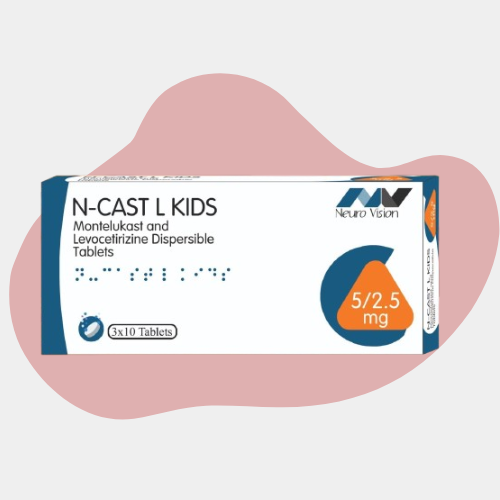
Description
N-Kast-L Dispersible Tablets (Montelukast 5mg & Levocetirizine 2.5mg) – Complete Reference
—
1. Pharmacokinetics
Montelukast (5mg):
Absorption: Rapidly absorbed after oral administration. Peak plasma concentrations are typically reached within 3–4 hours.
Distribution: Widely distributed in plasma, highly protein-bound (approximately 99%).
Metabolism: Metabolized in the liver, primarily via cytochrome P450 enzymes, particularly CYP3A4.
Excretion: Excreted mainly through the feces (~86%), with a small amount excreted via the urine (~6%).
Half-life: Approximately 2.7 to 5.5 hours.
Levocetirizine (2.5mg):
Absorption: Levocetirizine is rapidly absorbed after oral administration, with peak plasma concentrations occurring in about 0.9 hours.
Distribution: Levocetirizine is moderately protein-bound (~90%) and is distributed widely throughout the body.
Metabolism: Minimal metabolism; it is primarily excreted unchanged in the urine.
Excretion: Excreted mainly unchanged via the urine.
Half-life: Approximately 8 hours in healthy adults.
—
2. Pharmacodynamics
Montelukast (5mg):
Class: Leukotriene receptor antagonist.
Action: Montelukast selectively inhibits cysteinyl leukotriene receptors (CysLT1), preventing the effects of leukotrienes that play a key role in inflammation and bronchoconstriction in asthma and allergic rhinitis.
Effect: Reduces airway inflammation, alleviates bronchoconstriction, and improves respiratory symptoms.
Levocetirizine (2.5mg):
Class: Second-generation antihistamine.
Action: Levocetirizine is a selective H1-antagonist, meaning it blocks the action of histamine, a chemical that promotes allergic reactions.
Effect: Provides relief from allergy symptoms such as sneezing, itching, and runny nose by preventing histamine-mediated inflammation.
—
3. Clinical Indications
Allergic Rhinitis: Relief from symptoms of seasonal and perennial allergic rhinitis, such as sneezing, itching, and nasal congestion.
Asthma: Management of asthma symptoms, especially for controlling exercise-induced bronchoconstriction and overall lung function.
Chronic Urticaria: Treatment of chronic hives, providing relief from itching and discomfort.
Other Allergic Conditions: Useful in managing symptoms of other allergic conditions like allergic conjunctivitis.
—
4. Dosage Recommendations
Adults and Children (12 years and above):
Asthma & Allergic Rhinitis: 1 dispersible tablet (5mg Montelukast & 2.5mg Levocetirizine) once daily, preferably in the evening.
Children (6 to 12 years):
Asthma & Allergic Rhinitis: 1 dispersible tablet (5mg Montelukast & 2.5mg Levocetirizine) once daily, preferably in the evening.
Administration: The dispersible tablet should be dissolved in a small amount of water or taken directly. It should be taken once a day, preferably in the evening, to control allergic symptoms and improve breathing.
—
5. Safety Precautions
Allergy: Contraindicated in patients with hypersensitivity to Montelukast, Levocetirizine, or any of the components of the formulation.
Renal Impairment: Use with caution in patients with severe renal impairment. Levocetirizine clearance may be reduced in such patients.
Hepatic Impairment: Use with caution in patients with liver disease; no dose adjustment is required for Montelukast but monitor carefully.
Pregnancy and Lactation: Montelukast is classified as Category B during pregnancy. Levocetirizine should be used cautiously during pregnancy and lactation. Consult a healthcare provider before use.
CNS Effects: Levocetirizine may cause drowsiness. Caution is advised when performing tasks requiring alertness, such as driving or operating machinery.
Neuropsychiatric Effects: Montelukast has been associated with mood changes, depression, anxiety, and aggressive behavior, especially in children. Close monitoring is recommended.
—
6. Side Effects
Montelukast (5mg):
Common: Headache, abdominal pain, fatigue, dizziness, and sore throat.
Serious (rare): Neuropsychiatric symptoms such as aggression, agitation, hallucinations, depression, and suicidal thoughts.
Levocetirizine (2.5mg):
Common: Drowsiness, dry mouth, headache, dizziness, and fatigue.
Serious (rare): Tachycardia, difficulty urinating, allergic reactions (e.g., rash, swelling), and difficulty breathing.
—
7. Storage and Stability
Storage: Store below 30°C in a dry place, away from direct sunlight.
Shelf-life: 2–3 years.
Reconstituted Solution: Use immediately after reconstitution. Can be stored at 2–8°C for up to 6 hours.
Note: Keep out of reach of children. Do not freeze.
—
8. Overdose Management
Symptoms of Overdose: Overdose may cause excessive drowsiness, agitation, or restlessness.
Treatment: Symptomatic treatment is required. There is no specific antidote. Monitor vital signs, and provide supportive care as necessary.
—
9. Additional Notes
Drug Interactions: Montelukast may interact with other medications metabolized by the cytochrome P450 system. Levocetirizine may increase the sedative effects of CNS depressants.
Monitoring: Monitor renal function in patients with renal impairment, and be vigilant for any neuropsychiatric symptoms in pediatric patients using Montelukast for long periods.
Patient Advice: Patients should report severe side effects such as unusual bruising, jaundice, severe diarrhea, or any signs of a serious allergic reaction (e.g., swelling, rash, difficulty breathing)
Reviews
There are no reviews yet.